


KORORA NESTING BOXES
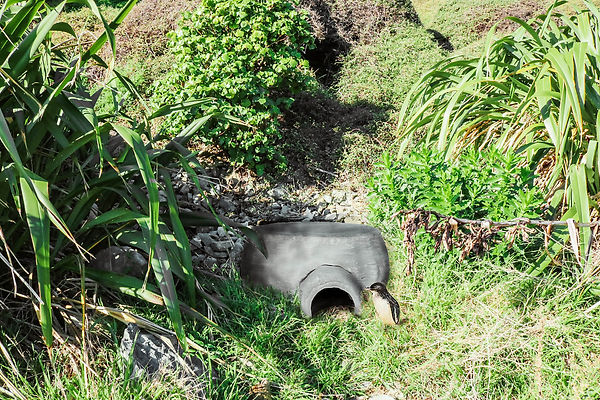
The 3D printed nesting boxes for Little Blue Penguins provide necessary shelter, create captivating collaborations, and utilise hybrid materials within a closed-loop system. Theoretically, the production and implementation of the nesting boxes would be achieved through a partnership between Sanford and New Zealand’s Department of Conservation. This localised production of 3D printed nesting boxes out of used plastic fishing gear is significantly noteworthy today, as Little Blue Penguins have been found to nest under houses due to the lack of protected areas along New Zealand’s coastline. In order to produce larger quantities of nesting boxes to solve this problem, an additional third-party candidate can collaborate with the project by funding the creation of a Little Blue Penguin nesting box. In doing so, the new candidate would be effectively recognised as a family, company or organisation that is doing their part to protect New Zealand’s native species. The use of 3D printing customisation can reinforce this “adopting” scheme, by producing exclusive engravings on the nesting box that represent the third party candidate or the native species they are protecting. Additionally, 3D printing customisation can utilise imperfect hybrid materials within this design idea as unique surface qualities can be exploited to mimic rock formations that are commonly found within the Little Blue Penguins natural habitats. Therefore, aquaculture rope filament is the predominant plastic fishing gear material that is upcycled and integrated within this design idea.
The nesting box design is 3D printed using filament made from used aquaculture ropes. While the grey tones and rough surface aspect of this material emphasises a rock-like quality, the 3D printed model employs organic curves and rigid corners to impersonate a rock formation further. The idea of resembling rock formations within the 3D printed nesting boxes means that New Zealand’s pristine landscape is not disrupted, as the nesting box blends into the natural environment. While the physical design only utilises one aquaculture rope filament, the variety in grey shades and surface qualities found in other aquaculture rope filaments ensures that a collection of different natural environments can be mimicked. Therefore, nesting boxes for Little Blue Penguins are not limited to light grey rock coastlines and can be employed throughout multiple habitats. Kororā is the Maori name for Little Blue Penguin and can be seen embossed on the back of the nesting box with the outline of a Little Blue Penguin next to it. This unique design attribute specifies the protection of Little Blue Penguins and can be customised according to what native New Zealand bird species are being protected by the 3D printed nesting box.
